
What if the persistent sense of being "stuck" is not a reflection of your competence, but a structural failure in the systemic architecture of your career? For high achievers managing the intersection of post-rehab recovery or the intricate pressures of a multi-generational family office, the traditional tropes of professional development often feel insufficient. You've likely realized that navigating complex professional challenges requires a level of intellectual rigor that standard coaching cannot provide; it's a process of engineering rather than just effort.
We recognize that your current plateau is often the result of a mismatch between your internal resilience and the external demands of a 2026 economy characterized by 4.2% inflation and rapid AI integration. This guide provides a methodical path toward strategic sovereignty, moving beyond superficial fixes to address the deep-seated barriers that impede your progress. We'll examine the specific frameworks required to resolve high-stakes obstacles, ensuring your next career transition is built on a foundation of clinical precision and sustainable performance.
Key Takeaways
- Learn to differentiate between technical problems and adaptive challenges to identify when a professional hurdle requires a fundamental shift in perspective rather than just a new skill set.
- Discover how the "Strategic Dyad" framework assists high-performance couples and executives in navigating complex professional challenges by aligning individual resilience with systemic health.
- Utilize the "Architecture of Independence" to manage high-stakes transitions, including post-rehab integration and the complex intergenerational demands of family-owned enterprises.
- Achieve "Strategic Sovereignty" by engineering an internal architecture that anticipates critical incidents and secures long-term agency over your professional trajectory.
Understanding the Anatomy of Complex Professional Challenges
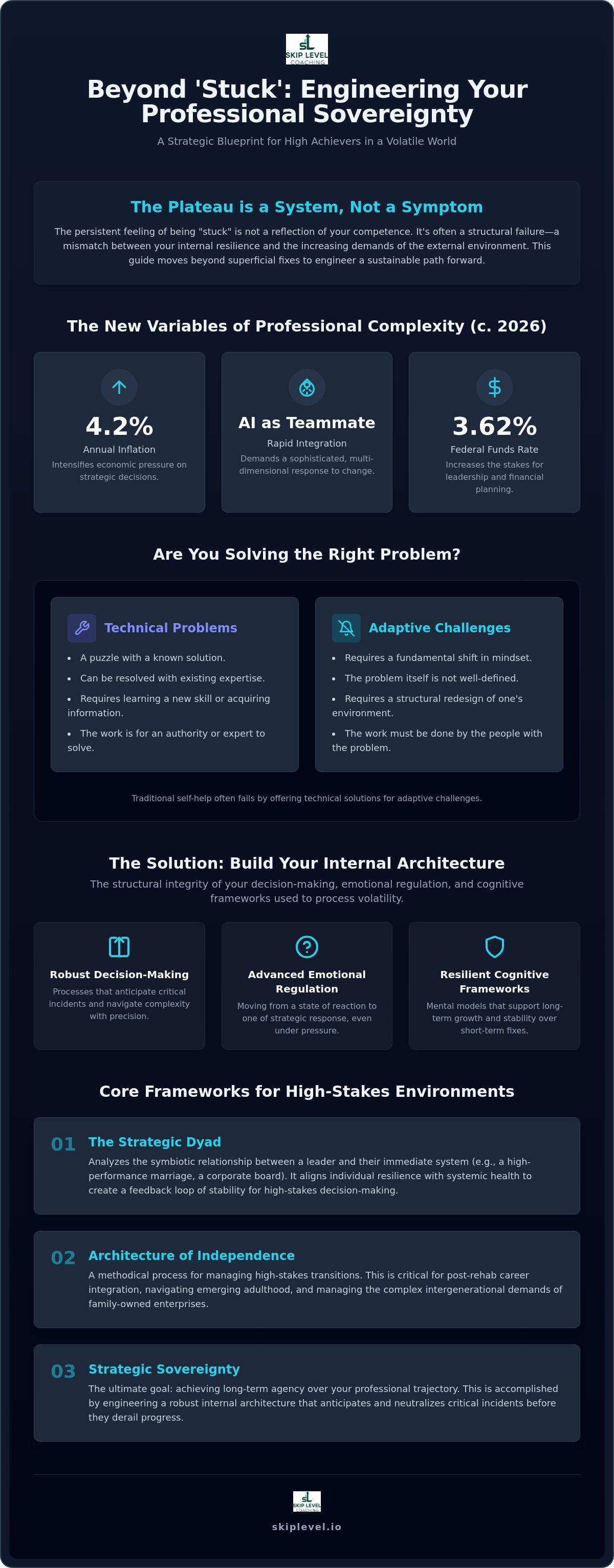
Professional obstacles are rarely isolated incidents; they are symptoms of a broader misalignment within complex adaptive systems. When navigating complex professional challenges, one must look past the immediate friction to see the psychological, systemic, and environmental variables at play. Most high-achieving leaders mistake adaptive challenges for technical problems. A technical problem is a puzzle with a known solution, often resolvable through existing expertise or skill acquisition. In contrast, an adaptive challenge requires a fundamental shift in the observer's mindset and the structural redesign of their professional environment. Traditional self-help literature fails here because it offers superficial platitudes where you require a rigorous blueprint for structural change.
Success in high-stakes environments depends on what we define as Internal Architecture. This refers to the structural integrity of your decision-making processes, emotional regulation, and the cognitive frameworks you use to process volatility. Without a robust internal foundation, even the most competent executive can find themselves in a state of professional stagnation that feels insurmountable. This "stuckness" is not a lack of effort; it's an architectural failure that necessitates a methodical, systems-based intervention.
The Intersection of Personal Psychology and Professional Performance
Your internal patterns inevitably dictate your external leadership outcomes. When executive functioning is compromised by unresolved psychological stressors or historical patterns, the ability to manage workplace dynamics diminishes. We often see professional "stuckness" as a direct symptom of architectural misalignment. If your internal system is calibrated for survival rather than strategic growth, you'll find yourself reacting to crises rather than engineering solutions. This is why our approach bridges the gap between clinical insight and executive performance, ensuring that the individual's psychological state supports their professional ambitions.
Why 2026 Demands a Strategic Approach to Complexity
The professional landscape of 2026 is defined by non-linear transitions and heightened volatility. With the U.S. annual inflation rate at 4.2% and AI transitioning from a tool to a teammate, the stakes for leadership have never been higher. Navigating complex professional challenges in this era requires more than just "soft skills," which are often insufficient for managing critical incidents or intergenerational wealth patterns. As the federal funds rate holds at 3.62%, the economic pressure on decision-makers intensifies the need for strategic sovereignty. You cannot rely on outdated, linear career models when the current environment demands a sophisticated, multi-dimensional response to change.
The Strategic Dyad: Balancing Individual Growth and Systemic Resilience
The Strategic Dyad represents a sophisticated evolution in executive performance, where we analyze the symbiotic relationship between an individual leader and their most immediate systems. Whether this system is a corporate board or a high-performance marriage, the architecture of one inevitably influences the other. Navigating complex professional challenges in 2026 requires more than just individual fortitude; it demands a dual-focused resilience that addresses both personal psychological health and the structural integrity of the environment. While many resort to generic stress management, we advocate for strategies for overcoming career challenges that prioritize systemic stability over fleeting emotional relief. This framework ensures that your personal growth isn't sabotaged by an unoptimized professional or domestic system. By aligning these two spheres, you create a feedback loop of stability that supports high-stakes decision-making.
Power Couples and the Architecture of Success
High-net-worth relationships often function as a silent engine for professional output. When both partners are high achievers, the relationship itself becomes a high-stakes environment where personal conflict can destabilize professional momentum. Resolving these frictions requires a shared strategic vision that treats the relationship as a foundational pillar of the leader's internal architecture. It's about engineering a partnership that supports long-term sustainability rather than just managing day-to-day logistics. We focus on resolving conflict through clinical precision, ensuring that the dyad remains a source of strength rather than a drain on executive functioning. This methodical approach allows couples to synchronize their ambitions without compromising individual sovereignty.
Systems-Based Personal Development
Systems-based development moves the needle from "grit" to "structure." Individual willpower is a finite resource, especially when facing the 2026 "productivity war" where employee engagement has dropped to 19% according to WebMD Health Services. Effective growth is engineered through deliberate, goal-oriented pathways that utilize external consultation to identify systemic blind spots. For those managing the weight of family business or wealth, this often involves emerging adulthood coaching to ensure that intergenerational transitions don't become critical incidents. Goal-directed coaching provides the necessary friction to test your internal architecture before it's challenged by external volatility. Our methodology focuses on this rigorous design, helping leaders move from being reactive to achieving strategic sovereignty. If you're ready to move beyond superficial fixes, exploring Power Couples Coaching can provide the structural support your professional trajectory demands.
Navigating Specialized Transitions: Post-Rehab and Emerging Adulthood
Transitions in a high-stakes career often represent the most vulnerable points in a leader's trajectory. While clinical support is vital for stabilizing mental health, it rarely addresses the strategic requirements of professional re-entry or the establishment of independent sovereignty. Navigating complex professional challenges during these periods requires a methodical bridge between recovery and performance. This is where the strategic architect becomes essential, focusing on the internal architecture needed to sustain high-level output without compromising personal stability. We distinguish our work from clinical psychotherapy by focusing on the hard engineering of professional success after a significant life disruption.
Sustainable Post-Rehab Integration Strategies
For the executive returning to the boardroom after a residential treatment program, the primary hurdle isn't just maintaining sobriety; it's the reconstruction of a professional identity that was perhaps previously tethered to maladaptive coping mechanisms. We move beyond the clinical focus of recovery to build a "sober performance" framework. This involves re-engineering executive functioning to handle the same high-pressure environments that may have contributed to the initial crisis. By navigating leadership in a complex world with a renewed internal system, the executive can achieve a level of professional excellence that is both resilient and sustainable. This transition coaching is unsentimental, focusing on the hard work of building a system that anticipates triggers and mitigates the risk of professional incidents. It's about ensuring your recovery doesn't just survive the job, but thrives because of a better-designed professional life.
The Architecture of Independence for Young Professionals
In high-net-worth families, the transition into professional adulthood is often complicated by the weight of intergenerational expectations and the safety net of existing wealth. We identify the "failure to launch" pattern not as a lack of ambition, but as a lack of independent architecture. Establishing professional sovereignty separate from the family office requires a deliberate, goal-directed framework for the third decade of life. Navigating complex professional challenges as an emerging adult involves creating a distinct professional identity that isn't merely an extension of a legacy. Our "Architecture of Independence" framework provides the necessary structure for young professionals to build their own strategic path, ensuring that their career is a product of their own agency. This process demands a high degree of intellectual rigor and a commitment to long-term sustainability, moving the young professional from a state of dependency to one of strategic sovereignty.
Building Internal Architecture: The Path to Strategic Sovereignty
Strategic sovereignty is the terminal objective of our methodology. It represents a state where an individual possesses total agency over their professional trajectory, uncoupled from external volatility or internal reactive states. Navigating complex professional challenges in 2026 requires this level of systemic control, as the professional landscape remains characterized by high inflation and rapid technological displacement. Unlike the superficiality of typical self-help language, we view sovereignty as a deliberate engineering feat. It's the result of a methodical, systems-based path toward resolution that prioritizes clinical precision over fleeting motivation. When your internal architecture is sound, professional obstacles cease to be existential threats and instead become variables to be managed within a controlled system.
Designing Resilience as a Deliberate System
Resilience is frequently discussed as an innate personality trait, yet we treat it as a structural requirement that must be engineered. It's not something you "find" during a crisis; it's a system you build during periods of relative stability. Our coaching sessions are intentionally unsentimental and goal-oriented, focusing on the hard work of identifying where your current internal structures are prone to fracture. By moving from reactive stress management to proactive strategic growth, you design a system that anticipates professional incidents before they manifest. This transition requires a commitment to intellectual rigor and a willingness to confront the underlying mechanisms of your performance. We don't offer quick fixes because sustainable resilience demands a fundamental redesign of your executive functioning.
Overcoming Professional Stagnation
Career plateaus are rarely the result of a lack of technical skill. More often, they are the manifestation of deep-seated intergenerational patterns or organizational gridlock that requires a sophisticated intervention. Identifying these patterns is the first step in moving from being a mere participant in your career to becoming its primary architect. For leaders facing high-stakes disruptions, Critical Incident Consultation provides a mechanism to unlock these deadlocks through a clinical lens. This process involves analyzing the systemic causes of stagnation, whether they stem from family business dynamics or architectural flaws in leadership style. By resolving these complex hurdles, you secure the strategic sovereignty necessary to navigate the remainder of your career with confidence and precision. This is the shift from managing the present to engineering the future.
Strategic Consultation for Critical Incidents and Organizational Resilience
Organizational resilience is the byproduct of deliberate systemic engineering, particularly when a firm faces a high-stakes disruption that threatens its structural integrity. Critical incident consultation serves as the mechanism for stabilizing these systems, providing a bridge between immediate volatility and long-term strategic health. Navigating complex professional challenges at the enterprise level requires a specialized lens that differentiates between emergency crisis intervention, which we do not provide, and strategic organizational consultation. While the former focuses on immediate safety, the latter is an intellectual and architectural process designed to preserve organizational integrity and leadership continuity. In an era where employee engagement has reached a low of 19%, the ability to manage these transitions with clinical precision is a competitive necessity.
Skip Level Coaching functions as a concierge-style guide for these high-stakes transitions, positioning ourselves as the strategic architect for both the individual leader and the broader organization. We recognize that a critical incident, whether it's a sudden leadership vacancy or a systemic failure in executive functioning, is often a symptom of an underlying architectural flaw. By addressing these issues through a methodical, systems-based path, we ensure that the resolution is sustainable and that the organization emerges with a more robust internal structure.
Managing High-Stakes Workplace Scenarios
Professional incident response demands a methodology that prioritizes long-term sustainability over fleeting fixes. When a leadership transition occurs, the risk to organizational integrity is significant; Paycor data from 2026 suggests that 42% of employees who leave believe their organization could have prevented their departure. Our approach involves a structured transition management framework that identifies and mitigates the psychological and systemic frictions inherent in high-stakes change. This isn't about generic "change management" but about the hard engineering of resilience within the executive team. By building a system that anticipates and absorbs these shocks, organizations can maintain their trajectory even during periods of extreme professional volatility.
The Skip Level Methodology: Bridging the Gap
The efficacy of our work is rooted in the clinical background of Dr. Jae LaHood, PsyD, whose expertise informs every aspect of our strategic professional coaching. This unique perspective allows us to bridge the gap between psychological insight and professional excellence, offering a level of intellectual rigor that standard executive coaching lacks. Our methodology is bespoke and high-touch, catering to executives and high-net-worth families who require a personalized approach to navigating complex professional challenges. We don't offer superficial advice; instead, we provide the architectural blueprints for strategic sovereignty. If you're prepared to move beyond the cycle of reactive management and toward a state of engineered independence, our Critical Incident Consultation provides the methodical path required to secure your professional future.
Securing Your Professional Future through Strategic Architecture
The pursuit of professional excellence in 2026 requires a departure from traditional, linear growth models. True mastery lies in the engineering of an internal system capable of absorbing volatility and resolving deep-seated systemic frictions. By shifting your focus from technical problem-solving to the construction of a robust internal architecture, you move beyond the limitations of standard performance metrics. Navigating complex professional challenges is no longer a matter of mere endurance; it's a deliberate exercise in strategic sovereignty.
Achieving this level of precision requires a partnership with a seasoned advisor who understands the intersection of psychological health and corporate performance. Led by Dr. Jae LaHood, PsyD, Skip Level Coaching provides bespoke, concierge-style guidance specialized in high-stakes professional transitions. Whether you're managing intergenerational wealth or re-entering the boardroom after a critical life event, a methodical path toward resolution is within reach. Schedule a Strategic Consultation with Skip Level Coaching to begin redesigning your professional trajectory. Your path toward sustainable resilience starts with a single, engineered step.
Frequently Asked Questions
What is the difference between professional coaching and clinical psychotherapy?
Professional coaching focuses on the architecture of future performance and strategic growth, whereas clinical psychotherapy is designed for the treatment of mental health disorders. Skip Level Coaching provides high-level strategic guidance for professional advancement and does not offer clinical psychotherapy. Our methodology is engineered for individuals who have already achieved clinical stabilization and are now seeking a methodical path toward professional excellence.
How does post-rehab integration coaching help high-achieving executives?
Post-rehab integration coaching bridges the gap between clinical recovery and the rigorous demands of the boardroom. It assists executives in navigating complex professional challenges by building a "sober performance" framework that anticipates triggers and mitigates the risk of professional incidents. This methodical approach ensures that the executive's return to a high-pressure environment is supported by a resilient internal architecture rather than just individual willpower.
What are the most common complex professional challenges for emerging adults in 2026?
Emerging adults in 2026 frequently struggle with establishing professional sovereignty separate from intergenerational wealth and navigating a workforce where AI has become a primary teammate. Many find themselves navigating complex professional challenges such as the "failure to launch" pattern in ambitious families. We address these hurdles through the "Architecture of Independence" framework, which provides a goal-directed path toward personal agency and professional identity.
Can coaching help with intergenerational wealth conflicts in family businesses?
Coaching provides a sophisticated mechanism for resolving intergenerational wealth conflicts by uncoupling individual professional agency from family legacy friction. We help clients design a strategic vision that honors their background while establishing their own professional sovereignty. This systems-based approach allows for the resolution of deep-seated barriers that often cause career plateaus within family offices or multi-generational enterprises.
What is Critical Incident Consultation, and when does an organization need it?
Critical Incident Consultation is a specialized intervention designed to stabilize an organization during high-stakes disruptions such as sudden leadership vacancies or systemic failures in executive functioning. An organization requires this consultation when a specific event threatens its structural integrity or leadership continuity. Our role is to provide a methodical, systems-based path toward resolution, ensuring that the organization maintains its momentum despite the volatility.
How does Skip Level Coaching address executive functioning support for adults?
We address executive functioning support by identifying and correcting architectural flaws in a leader's decision-making and emotional regulation systems. This process involves re-engineering the cognitive frameworks required to process volatility and manage high-stakes professional obstacles. By treating executive functioning as a deliberate engineering feat, we help adults move from a reactive state to one of proactive strategic growth.
What does "Strategic Sovereignty" mean in a professional context?
Strategic Sovereignty is the ultimate state of professional agency where a leader possesses total control over their career trajectory. It means your path is no longer dictated by external economic volatility or internal reactive patterns. Through the construction of a robust internal architecture, you achieve a level of independence that allows you to navigate the professional landscape with calm confidence and clinical precision.
Is Skip Level Coaching appropriate for emergency crisis intervention?
Skip Level Coaching does not provide emergency crisis intervention, acute mental health treatment, or in-patient addiction services. Our methodology is designed for the strategic transition and long-term sustainability that follows initial clinical stabilization. We serve as a "Strategic Architect" for those who are ready to do the hard work of building resilience and internal architecture after a crisis has been stabilized.