
The most dangerous phase of a high-achieving career is not failure, but the high-performance plateau where your current capabilities have become your ceiling. You've likely reached a point where you're exceptionally good at work that no longer demands your full intellectual or creative capacity. It's a frustrating paradox where external success masks an internal sense of decay. Overcoming professional stagnation requires more than a new job title; it demands a fundamental re-evaluation of the disconnect between your proven track record and your internal ambition. You aren't lacking talent, but you may be trapped by the very skills that facilitated your initial rise.
This article provides a sophisticated framework for shifting from a passive plateau to engineered growth by addressing the psychological and systemic architectures of your career. We'll move beyond the superficiality of typical self-help to explore a methodical path toward professional sovereignty. You'll gain clarity on the internal barriers that stall momentum and learn how to navigate high-stakes transitions with clinical precision. We will analyze how to align your internal psychological state with external professional outcomes, ensuring your next move is a deliberate step toward complexity rather than a lateral shift into more of the same.
Key Takeaways
- Define professional stagnation as a structural misalignment between your internal architecture and the increasing complexity of the next leadership tier.
- Develop a methodical framework for overcoming professional stagnation by identifying the "capability trap" where high performance in familiar tasks prevents the acquisition of strategic skills.
- Evaluate the impact of executive functioning on your professional ceiling, focusing on how cognitive load and decision fatigue create invisible barriers to growth.
- Analyze the systemic and intergenerational patterns that influence your career trajectory, including the role of the "Strategic Dyad" in maintaining the professional status quo.
- Shift from reactive, fear-based decision-making to a goal-directed methodology that engineers a sustainable path toward professional sovereignty.
The Anatomy of Professional Stagnation in High-Performance Careers
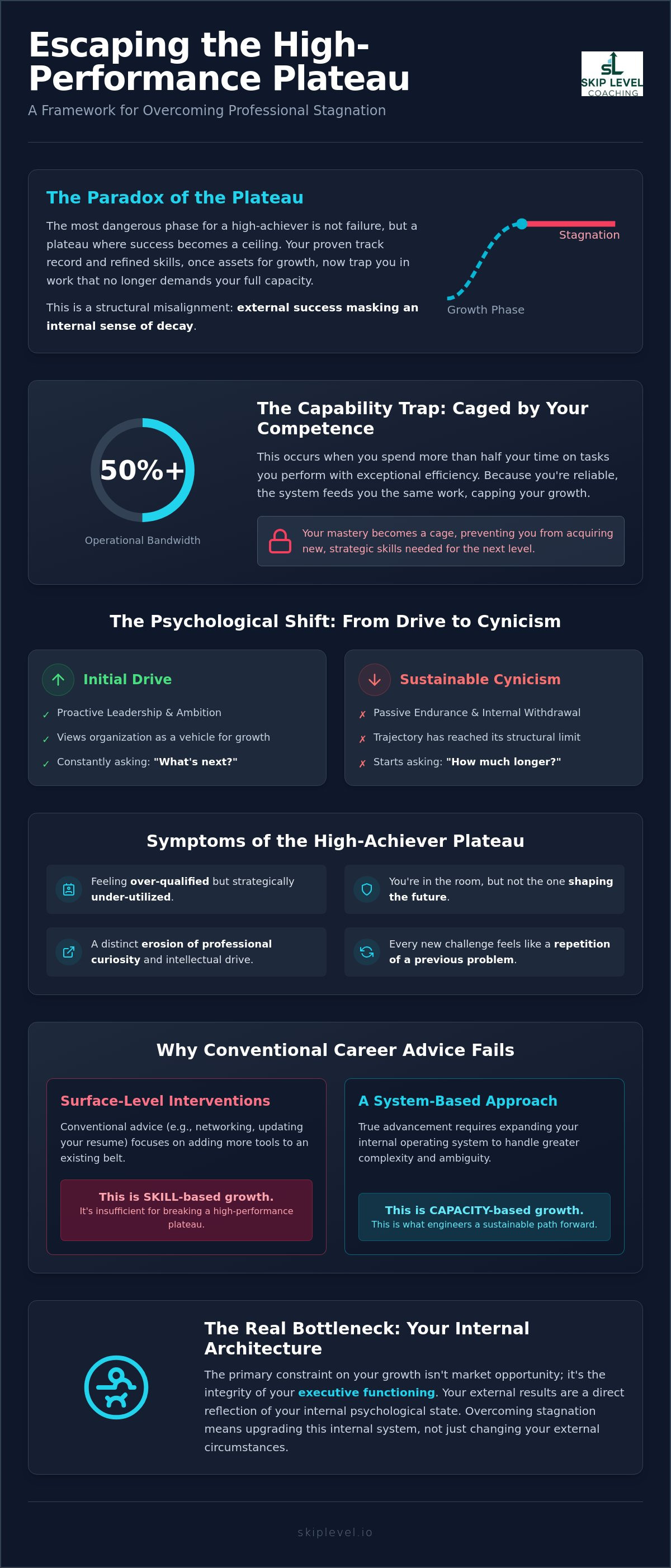
Professional stagnation in high-stakes environments is rarely the result of a deficit in effort or ambition. Instead, it represents a structural misalignment between an individual's internal architecture and the external organizational demands. For the high achiever, the plateau is often a byproduct of success itself, a state where you've optimized your performance for a specific altitude and now find the oxygen thin for further ascent. Overcoming professional stagnation requires a clinical diagnostic of this state, moving beyond the simplistic notion of "being stuck" to understand the systemic forces at play. It's a complex intersection where your proven track record meets a lack of future-facing complexity.
This phenomenon frequently manifests as the "capability trap." This occurs when you find yourself spending 50% or more of your operational bandwidth on functions you can perform with exceptional efficiency, yet these tasks provide no intellectual nourishment or strategic advancement. You're trapped by your own competence; because you're reliable, the system continues to feed you the same level of work, effectively capping your professional runway. This is a sophisticated variation of Peter's plateau, where the stagnation isn't caused by reaching a level of incompetence, but by a mastery that has become a cage. You're doing what you can do, rather than what excites or stretches you.
As this misalignment persists, the psychological impact is profound. The initial drive that fueled your rise begins to erode, replaced by a form of "sustainable cynicism." This isn't a loud, disruptive rebellion, but a quiet, internal withdrawal where you no longer see the organizational structure as a vehicle for your ambition. This shift from proactive leadership to passive endurance is a critical warning sign that your current professional trajectory has reached its structural limit. When you stop asking "what's next" and start asking "how much longer," the architecture of your career requires an immediate intervention.
Symptoms of the High-Achiever Plateau
High achievers on a plateau often feel over-qualified but strategically under-utilized. You're in the room, but you aren't the one shaping the future. This leads to a distinct erosion of professional curiosity. When every challenge feels like a repetition of a previous problem, the brain switches to an energy-saving mode. It's vital to recognize the difference between a temporary seasonal lull and a hard structural ceiling. A ceiling suggests that no matter how much effort you exert, the current system cannot accommodate your next level of growth.
Why Conventional Career Advice Fails High Performers
Standard recommendations like "networking more" or "updating your CV" are often insufficient for the executive-level shifts required to break a high-performance plateau. These are surface-level interventions for what is essentially a capacity problem. Conventional advice focuses on skill-based growth, adding more tools to an existing belt. However, true advancement for a senior leader requires capacity-based growth, expanding the internal operating system to handle greater levels of complexity and ambiguity. A systems-based diagnostic is necessary to identify where the internal psychological barriers meet the external systemic constraints.
The Internal Architecture: Why Executive Functioning Dictates Your Ceiling
For the high-level executive, the primary constraint on growth isn't usually a lack of market opportunity or technical skill. It's the integrity of their internal architecture. Executive functioning serves as the internal operating system that manages complex tasks, prioritizes strategic initiatives, and regulates emotional responses to high-stakes pressure. When this system becomes overloaded, professional inertia sets in. This is a critical realization for those focused on overcoming professional stagnation; you cannot engineer a higher-level career on a taxed or outdated internal system. Your external results are a direct reflection of this internal psychological state.
Many professionals attempt to resolve a stall by increasing their output, yet "working harder" often exacerbates the very deficits that created the plateau. High cognitive load and chronic decision fatigue lead to a narrowing of perspective, making it nearly impossible to identify the strategic pivots required to break out of the mid-career plateau. When your executive resources are consumed by daily firefighting, you lose the capacity for the high-level visionary work that defines the next tier of leadership. This creates a cycle where effort increases while impact remains static, eventually leading to burnout rather than advancement.
The Core Components of Professional Executive Function
Emotional regulation is the silent engine of corporate navigation. Without it, the friction of organizational politics becomes an insurmountable barrier. Cognitive flexibility allows a leader to abandon a failing strategy before the runway ends, while working memory enables the synthesis of vast amounts of data into a coherent strategic plan. These aren't just personality traits. They're measurable components of your professional architecture that dictate how much complexity you can effectively manage.
Building Internal Architecture for the Next Level
Building a resilient internal architecture requires a methodical approach rather than a quick fix. It involves leveraging neuroplasticity to re-engineer how you process stress and make decisions. Our executive coaching identifies specific "leaks" in your executive functioning system, such as chronic procrastination or difficulty with task switching, that prevent you from reaching the next level of complexity. This systematic approach is essential for overcoming professional stagnation at the highest levels, where the stakes are too great for trial and error. By strengthening these internal foundations, you create the capacity for sustainable growth that isn't dependent on sheer volume of work.
Deconstructing the Runway: Identifying Systemic and Intergenerational Barriers
Professional growth doesn't occur in a vacuum. For many high achievers, the barriers to overcoming professional stagnation are woven into the fabric of their personal and familial systems. These systemic constraints often act as invisible anchors, slowing momentum even when the individual's performance remains high. To move beyond a plateau, one must analyze the broader ecosystem, including the "Strategic Dyad" of personal relationships and the weight of intergenerational expectations. These forces often dictate the height of your professional ceiling long before you reach the boardroom.
A significant hurdle in high-stakes environments is the transition from being a high-level executor to achieving "Strategic Sovereignty." Many professionals are expertly trained to fulfill the visions of others, whether those visions belong to a corporate board or a family legacy. This role, while lucrative, eventually leads to a structural misalignment. You're executing at a high level, but you lack the autonomy to architect your own professional future. True sovereignty requires a methodical dismantling of these external expectations to create space for your own strategic ambition.
Intergenerational Patterns and Professional Autonomy
For emerging adults in high-net-worth families, the "architecture of independence" is often compromised by the very resources meant to support it. The psychological weight of legacy can create a "failure to launch" dynamic that has nothing to do with capability and everything to do with systemic pressure. When your professional runway is pre-paved by a family business or intergenerational wealth, the drive for individual achievement often conflicts with the need to maintain established patterns. Breaking free from these invisible ceilings requires more than a career pivot; it demands a clinical re-engineering of your relationship with family legacy and professional identity.
The Power Couple Dynamic: Growth or Stagnation?
Dual-career "power couples" face a unique set of challenges where the rapid ascent of one partner can inadvertently create a professional plateau for the other. Without intentional transition management, the relationship's strategic framework can become lopsided, favoring the stability of the collective unit over the individual growth of both parties. This often leads to a quiet cynicism in the partner whose career has stalled. Our Power Couples Coaching provides a systems-based path to resolve these imbalances. By treating the relationship as a high-performance dyad, we ensure that mutual growth is engineered into the partnership, allowing both individuals to pursue sovereign professional trajectories without compromising the integrity of the union.
Engineering the Pivot: A Systems-Based Approach to Sustainable Growth
Overcoming professional stagnation requires a shift from reactive, fear-based decision-making to a rigid, goal-directed framework. This transition isn't a search for inspiration; it's a deliberate engineering project. By utilizing the Skip Level Coaching methodology, high achievers bridge the gap between clinical psychological insight and professional excellence, creating a robust transition architecture for high-stakes moves into new industries or senior executive roles. When stagnation evolves into a professional crisis, our Critical Incident Consultation provides the immediate, systems-based intervention necessary to stabilize the trajectory and prepare for a strategic pivot.
The pivot from a high-performance plateau to sovereign growth is an engineering task, not a motivational one. It demands a departure from the "tactical hunt"-the constant search for the next immediate win-and an entry into the "strategic architect" phase. This systematic approach is essential for overcoming professional stagnation at the highest levels, where the stakes are too great for trial and error. By strengthening your internal foundations, you create the capacity for sustainable growth that isn't dependent on sheer volume of work.
Step 1: The Structural Diagnostic
Audit your runway. Is the limitation external, residing in the organization, or internal, residing in your executive functioning? You must identify specific "Capability Trap" tasks, those high-competence but low-fulfillment activities, and engineer their immediate delegation or elimination. A critical exercise in this stage is to write a single sentence defining your professional ceiling with a specific date of onset. This clarity transforms a vague feeling of being "stuck" into a concrete problem that can be solved with architectural precision.
Step 2: Strengthening the Executive Core
The second phase focuses on strengthening the internal operating system. This involves goal-oriented coaching sessions designed to close executive functioning gaps identified in the diagnostic. You'll move toward a "strategic architect" mindset that prioritizes high-leverage decision-making. This shift establishes a plan for strategic sovereignty, ensuring your professional value is no longer tied to sheer output but to the complexity of the problems you resolve.
Step 3: Executing the Sustainable Transition
Execution requires an emotional style that's empathetic yet unsentimental regarding your professional legacy. You're building for the future, not mourning the past. For those navigating the complexities of recovery, we integrate Post-Rehab Integration Coaching to ensure high-performance resilience remains a cornerstone of the new architecture. Progress is measured through systems-based personal development metrics, focusing on long-term sustainability rather than fleeting, immediate results.
Beyond the Plateau: Strategic Coaching for High-Stakes Transitions
Navigating the final stages of overcoming professional stagnation requires more than a tactical shift; it demands a strategic investment in professional sovereignty. For high achievers, the barriers to growth are rarely about a lack of information or technical ability. Instead, they're rooted in the complex interplay between internal psychological architecture and external systemic pressures. Specialized coaching serves as the mechanism for dismantling these barriers. By engaging an authoritative, clinical guide, you move beyond surface-level symptoms to confront the deep-seated patterns that have historically dictated your professional ceiling. This isn't about minor adjustments; it's about a fundamental re-engineering of your career's trajectory.
Bespoke, high-touch consultation is essential when dealing with the nuances of intergenerational wealth, family business legacies, or the "Strategic Dyad" of power couples. These aren't obstacles that can be resolved with a standard management framework. They require a sophisticated understanding of how legacy impacts autonomy and how psychological leaks in executive functioning can stall even the most brilliant careers. Skip Level positions itself as the architect of your next professional decade, providing the intellectual rigor necessary to bridge the gap between mental health and professional advancement. We focus on long-term sustainability rather than the fleeting results of superficial strategy training.
The Concierge Approach to Executive Growth
Boardroom-level growth is frequently hindered by the superficiality of typical self-help language. A "Strategic Architect" understands that your performance is inextricably tied to your psyche. We integrate professional advancement with long-term psychological sustainability to ensure that your next transition is a deliberate step into a higher level of complexity. This high-touch service is designed for individuals who value intellectual depth and a personalized, methodical approach to resolution. It's a specialized path for those who recognize that their internal architecture must evolve to meet the demands of senior leadership.
Initiating Your Strategic Transition
Determining your readiness for a goal-directed coaching partnership is the first step in re-engineering your professional architecture. It requires a willingness to look past the "tactical hunt" and focus on building a sustainable internal system that supports your highest ambitions. If you're prepared to move from a passive plateau to engineered growth, the path forward is methodical, thorough, and focused on your unique needs. You don't have to navigate the complexity of a high-stakes transition without a systems-based guide to lead the way.
Engage with Skip Level Coaching for a systems-based path to resolution.
Architecting Your Professional Sovereignty
The transition from a high-performance plateau to a state of engineered growth is not a matter of chance, but a result of deliberate structural alignment. We've explored how overcoming professional stagnation requires a clinical diagnostic of your internal executive functioning and a thorough deconstruction of the systemic barriers that anchor your progress. Whether you're navigating the complexities of a family business legacy or managing the delicate balance of a power couple dynamic, the path forward demands a methodical, systems-based approach rather than superficial career hacks.
Led by Dr. Jae LaHood, PsyD, Skip Level Coaching specializes in high-stakes executive and family business transitions, providing the intellectual rigor necessary to bridge the gap between psychological insight and professional performance. It's time to move beyond the capability trap and reclaim your strategic autonomy through a personalized, high-touch consultation process. You have the capacity for greater complexity; you simply need the internal architecture to support it. Schedule a Strategic Consultation with Skip Level Coaching to begin re-engineering your professional future with clinical precision and calm confidence.
Frequently Asked Questions
What are the first signs of professional stagnation in high achievers?
The first signs of professional stagnation include a persistent feeling of being "over-qualified but under-utilized" and a shift toward sustainable cynicism. You might notice that you're achieving high results in tasks that no longer demand your full cognitive capacity. This mismatch between ambition and output is a primary indicator that overcoming professional stagnation will require a methodical re-evaluation of your internal architecture and current organizational trajectory.
How does executive functioning impact my ability to get promoted?
Executive functioning serves as the internal operating system that dictates your capacity for handling increased complexity. If your core components, such as cognitive flexibility and emotional regulation, are taxed by decision fatigue, you'll lack the bandwidth required for high-level strategic planning. Promotions often stall not because of a lack of skill, but because your current internal architecture cannot support the cognitive load of the next leadership tier.
Can professional stagnation be solved without changing companies?
Overcoming professional stagnation doesn't always necessitate an external move; it often requires an internal re-engineering of your current role. By identifying and delegating "capability trap" tasks, you can create the strategic sovereignty needed to pursue higher-leverage work within your existing organization. This systems-based approach focuses on shifting your mindset from a tactical executor to a strategic architect of your own professional space.
How do intergenerational wealth patterns affect my career growth?
Intergenerational wealth patterns can create invisible ceilings by prioritizing family legacy over individual professional autonomy. This often manifests as an "architecture of dependence" where the individual's drive for achievement is compromised by systemic familial pressures. Navigating these transitions requires a clinical guide who can help you dismantle these patterns to build a personalized path toward professional independence and long-term psychological sustainability.
What is the "capability trap" and how do I exit it?
The capability trap occurs when you spend the majority of your bandwidth on functions you perform with exceptional efficiency but find intellectually unfulfilling. You're essentially trapped by your own competence; because you're reliable, the system continues to feed you tasks that cap your growth. Exiting this trap requires a methodical audit of your current "runway" and a deliberate plan to engineer the delegation of these low-leverage activities.
How does Skip Level Coaching differ from traditional career coaching?
Skip Level Coaching differs from traditional career coaching by bridging clinical psychological insight with high-level executive performance strategy. While traditional methods often focus on superficial skill-based growth like resume updates, our approach addresses the underlying internal architecture and systemic barriers. We offer a bespoke, high-touch consultation that confronts deep-seated patterns, including those found in power couples and high-stakes transitions, ensuring sustainable, long-term resolution.
Is professional stagnation a psychological issue or a corporate one?
Professional stagnation is a multifaceted issue that exists at the intersection of internal psychological states and external corporate structures. It's rarely just one or the other; instead, it's a structural misalignment where your current capabilities have become your ceiling. Resolving this requires a dual approach that addresses both your internal executive functioning and the systemic constraints of your organizational environment to engineer a path toward sovereignty.
What is the role of critical incident consultation in career growth?
Critical incident consultation provides an immediate, systems-based intervention when professional stagnation leads to a state of crisis. It's designed to stabilize a high-stakes situation, such as a sudden leadership transition or a significant professional failure, allowing for a strategic pivot. By addressing the immediate disruption with clinical precision, we create the necessary space to re-evaluate your long-term trajectory and build a more resilient professional architecture.