
Adulthood isn't a milestone you reach simply by turning thirty; it's a deliberate architecture that must be engineered through strategic psychological sovereignty. For the modern high-achiever, the traditional markers of success often feel out of reach, replaced by a persistent anxiety over delayed milestones and a lack of clear executive structure. This is why emerging adulthood coaching has become an essential discipline for those who refuse to settle for professional stagnation. It's a methodical, systems-based approach designed to replace haphazard growth with a calculated path toward personal and professional mastery.
You likely recognize the heavy friction between your high-level ambitions and the reality of your current progress. It's common to feel the weight of intergenerational expectations while lacking the internal architecture required to navigate a complex, 2026 professional landscape. This article will show you how to master the transition into high-performance adulthood by leveraging a framework focused on measurable progress and emotional resilience. We'll examine the strategic shift from surviving to thriving, providing a clear roadmap for building the sustainable executive functioning necessary for long-term sovereignty.
Key Takeaways
- Establish a robust internal architecture that bridges the gap between psychological insight and professional advancement through a methodical, systems-based framework.
- Discover why specialized emerging adulthood coaching is the critical driver for high-achievers navigating the shifting economic and developmental milestones of the third decade.
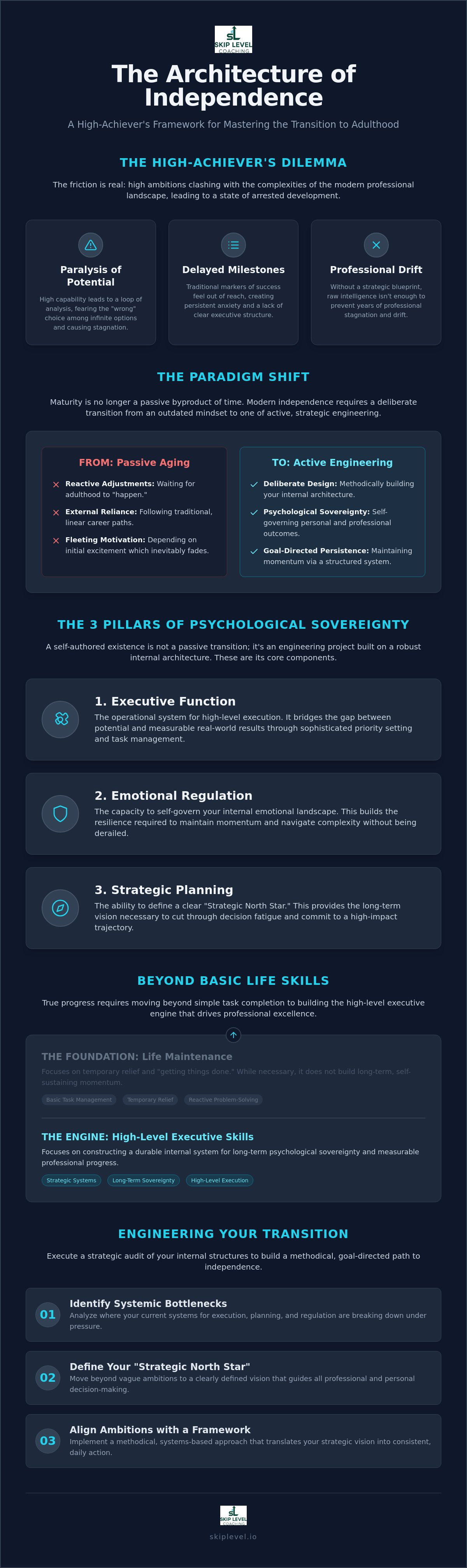
- Identify the three pillars of psychological sovereignty-executive function, emotional regulation, and strategic planning-that facilitate the transition to self-authored independence.
- Distinguish between basic life maintenance and high-level executive skills to ensure your personal development translates into measurable professional progress.
- Execute a strategic audit of your current internal structures to identify systemic bottlenecks and align your professional ambitions with a defined "Strategic North Star."
Defining Emerging Adulthood: Why the Third Decade Requires a Strategic Framework
Emerging adulthood is no longer a brief, transitional bridge between childhood and responsibility; it's a distinct developmental phase spanning from ages 18 to 29. In the 2026 economic landscape, characterized by algorithmic job markets and credential inflation, traditional milestones like homeownership or linear career paths have shifted significantly. Many young adults fall into the trap of "passive aging," assuming that maturity will arrive as a natural byproduct of time. In reality, modern independence requires "active engineering." This is why the concept of the Architecture of Independence is so critical. It represents a required internal structure that must be methodically built, ensuring that the transition into adulthood is a deliberate act of design rather than a series of reactive adjustments.
The Shift from Adolescence to Strategic Sovereignty
The mid-twenties are marked by significant neurobiological transitions, particularly within the prefrontal cortex, which governs executive function and long-term planning. These biological shifts coincide with the psychological weight of "infinite choice." While previous generations had clearer, more restricted paths, today's high-achievers face a density of options that often leads to decision fatigue rather than true freedom. Strategic sovereignty is the antidote to this overwhelm. It's defined as the ability to self-govern both professional and personal outcomes through a disciplined internal system. Achieving this level of autonomy requires more than just willpower; it demands a sophisticated understanding of one's own cognitive and emotional landscapes to maintain momentum in an increasingly complex world.
The High-Achiever Trap: When Potential Meets Stagnation
High-IQ individuals often encounter a specific "paralysis of potential." Because they possess the capability to excel in multiple domains, they frequently find themselves stuck in a loop of analysis, unable to commit to a single trajectory for fear of making a suboptimal choice. This stagnation is often compounded by intergenerational expectations, where the pressure to replicate a parent's success conflicts with the need for individual autonomy. Intelligence alone is insufficient for navigating these high-stakes transitions. Without specialized emerging adulthood coaching, even the most gifted individuals can face years of professional drift. They may possess the raw data and the cognitive tools, but they lack the executive architecture required to translate that potential into measurable, real-world results. Emerging adulthood coaching provides the strategic blueprint necessary to bypass these common developmental plateaus and accelerate the journey toward high-performance independence.
The Core Pillars of Psychological Sovereignty and Internal Architecture
Moving from a state of external reliance to a self-authored existence isn't a passive transition; it's a rigorous engineering project. This internal architecture is built upon three primary pillars: Executive Function, Emotional Regulation, and Strategic Planning. While traditional support systems often focus on temporary relief or basic life skills, emerging adulthood coaching prioritizes the construction of these pillars to ensure long-term psychological sovereignty. Research from the International Coaching Federation underscores the Benefits of Coaching for Young Adults, specifically noting how a structured approach aids in gaining clarity and developing the persistence required for modern success. By prioritizing goal-directed persistence over fleeting motivation, an individual can maintain professional momentum even when the initial novelty of a role or venture dissipates. This methodical approach transforms the chaotic energy of the twenties into a focused, high-performance engine.
Engineering Executive Function for Complex Environments
High-level execution requires a sophisticated system for priority setting. There's a fundamental difference between "getting things done," which is tactical maintenance, and "strategic execution," which aligns daily actions with long-term trajectories. Cognitive flexibility is vital; it allows a high-achiever to pivot when environmental conditions shift without compromising core objectives. Developing these systems is essential for those who require bespoke coaching frameworks to translate intellectual capacity into functional daily output.
Navigating Intergenerational Wealth and Autonomy
For individuals in high-net-worth family systems, the path to independence is often obscured by heritage. The pressure to succeed as a "successor" can stifle the drive to become an "innovator." Strategic Sovereignty is the ability to build a professional identity that's independent of family name. It involves a complex psychological transition where one leverages existing resources without becoming professionally dependent on them. This requires identifying personal values and translating them into a unique professional contribution.
Resilience serves as the mortar between these architectural pillars. It isn't a vague sense of "toughness" but a calculated capacity to manage emotional volatility during inevitable professional setbacks. Sustainable momentum is built on the foundation of goal-directed persistence rather than the unreliable spikes of inspiration. Unlike motivation, which is a fickle neurochemical state, persistence is a systemic habit that can be engineered. Engaging in emerging adulthood coaching helps codify these habits, transforming raw potential into a disciplined engine of professional excellence. This structural integrity is what allows a high-achiever to navigate the complexities of the modern boardroom with the same precision they apply to their personal development.
Beyond Basic Life Skills: Executive Coaching as the Engine of Professional Excellence
High-achieving individuals often find the standard discourse around adulthood insufficient. While many programs focus on "life skills" like laundry or basic budgeting, emerging adulthood coaching functions as early-stage executive coaching for those entering high-stakes professional environments. The distinction lies in the objective. Life skills are maintenance; they prevent failure. Executive skills are growth; they engineer success. Mastering professional systems in your twenties doesn't just accelerate your career path. It builds the internal capacity required to prevent the mid-career burnout that often strikes those who have relied on raw talent rather than structured systems. The ROI of this early strategic investment is measured in decades of sustained performance and the avoidance of the "potential trap" discussed previously.
The financial and psychological cost of a misspent decade is astronomical. When high-achievers lack a strategic framework, they often spend their thirties correcting the systemic errors of their twenties. By establishing an executive engine early, you secure a competitive advantage that compounds over time. This isn't about quick fixes. It's about the hard work of building resilience and internal architecture that can withstand the pressures of the C-suite or high-level entrepreneurship. This proactive engineering ensures that your trajectory is determined by your ambition rather than your unexamined habits.
The Systems-Based Personal Development Methodology
To achieve professional excellence, you must treat "Life as an Organization." This requires moving beyond intuition and into a state of managed execution. A robust internal architecture relies on feedback loops that link internal psychological states with external professional outputs. High-achievers don't just "try harder." They build systems that include data-driven self-assessment and objective metrics to track cognitive load and decision-making quality. Identifying where systemic bottlenecks in personal workflow hinder professional progress allows for strategic resource allocation. You must treat your time and emotional energy as capital to be strategically deployed. This methodical approach ensures that growth is a deliberate, engineered process rather than a fortunate accident.
Mitigating Professional Stagnation Before It Starts
Career drift in your twenties is often invisible until it's too late. Early warning signs aren't failure, but rather a plateauing of challenge or a reliance on "going through the motions." While mentorship provides anecdotal advice, emerging adulthood coaching offers a structural intervention. It provides the "Skip Level" perspective. This is the ability to view your current developmental stage from the vantage point of future leadership requirements. Mentorship is often a passive transfer of experience; coaching is an active reconstruction of your executive architecture. By identifying and resolving developmental plateaus now, you bypass the stagnation that stalls many high-potential careers before they truly begin. It's the difference between following a path and architecting a legacy.
Engineering Your Transition: A Methodical Approach to Goal-Directed Independence
Constructing a sustainable path to independence requires a departure from the vague aspirations of "finding oneself" and a commitment to a rigorous, step-by-step engineering process. For the high-achiever, this transition is managed through a sequence of deliberate interventions that align internal psychological states with external professional requirements. Unlike generic self-help models, emerging adulthood coaching utilizes a structured methodology to ensure that every developmental milestone is met with precision. This process begins with a systemic audit of your current internal architecture to identify the specific bottlenecks, whether cognitive or emotional, that hinder your progress. By isolating these friction points, we can move toward defining a "Strategic North Star" that synthesizes your core personal values with your highest professional ambitions.
- Step 1: Systemic Audit. Conduct a thorough evaluation of your current executive functioning and psychological barriers to identify where your current systems are failing.
- Step 2: Strategic North Star. Define the high-level objectives that serve as the ultimate guide for your professional and personal evolution.
- Step 3: Sovereignty Roadmap. Develop a detailed, time-bound plan that breaks down your North Star into manageable, measurable milestones.
- Step 4: Operational Excellence. Implementation of high-level executive functioning systems to manage daily tasks, decision-making, and priority setting.
- Step 5: Iterative Refinement. Establishing a consistent cadence for evaluating progress and adjusting the architecture as your environment shifts.
Constructing Your Sovereignty Roadmap
A Sovereignty Roadmap is a dynamic blueprint for engineered independence. In the context of the third decade, differentiating between genuine milestones and mere distractions is a critical executive skill. High-achievers often fall victim to "shiny object syndrome," pursuing credentials or roles that look impressive but don't contribute to their long-term strategic sovereignty. To combat this, we focus on 12-month strategic windows. This timeframe is long enough to achieve significant structural change but short enough to maintain high-intensity focus and urgency. By mapping out these windows, you create a clear visual of how specific actions today compound into the independence you require tomorrow.
Cadence of Accountability: The Role of the Strategic Advisor
Building a new internal architecture is difficult work that's rarely successful in isolation. External accountability is a mandatory requirement for the formation of new executive habits. In a high-level coaching relationship, this accountability is delivered through "unsentimental empathy." This approach acknowledges the complexity of your situation while maintaining a relentless focus on the work required to resolve it. It's not about providing comfort; it's about providing the structural support necessary for growth. Skip Level Coaching facilitates this specific cadence, ensuring that you don't just plan for independence but actively inhabit it. To begin building your own framework for success, you can explore our specialized coaching services designed for the modern high-achiever.
This steady pace of refinement mirrors the professional world's requirements. It teaches you to manage yourself with the same intellectual rigor you'd apply to a corporate project or a wealth management strategy. By establishing this cadence early, you're not just solving the problems of your twenties; you're installing the executive operating system that will power the rest of your career.
Skip Level Coaching: Bridging Psychological Insight with Strategic Ambition
Skip Level Coaching, founded by Dr. Jae LaHood, PsyD, represents the pinnacle of specialized intervention for the third decade. Our methodology is built on the "Skip Level" philosophy, which seeks to accelerate personal evolution by bypassing the common developmental plateaus that often stall high-potential individuals. This isn't a generic mentorship program; it's a high-touch, concierge-style service designed for those who value intellectual rigor and a bespoke approach to personal development. We operate at the intersection of psychological depth and professional performance, providing the strategic framework necessary for individuals and high-net-worth families to navigate the complexities of modern independence. It's vital to clarify that Skip Level Coaching is a goal-oriented practice focused on external professional outcomes and internal executive architecture; we do not offer clinical psychotherapy or crisis intervention.
The distinction between traditional support and our systems-based approach lies in the commitment to engineered results. While competitors may offer compassionate expertise, we focus on the hard work of building resilience and internal structures that command respect in the boardroom. This specialized emerging adulthood coaching ensures that your transition into high-performance adulthood is not left to chance. By applying clinical precision to strategic ambition, we help you secure a competitive advantage that is both measurable and sustainable.
The Strategic Architect: Working with Dr. Jae LaHood
Working with a coach who holds a PsyD provides a level of clinical precision that traditional life coaching lacks. Dr. Jae LaHood acts as a Strategic Architect, helping you dismantle the systemic barriers to your autonomy and rebuild a more resilient internal structure. This PsyD-led approach ensures that the transitions we engineer are not just rapid, but sustainable over the long term. By focusing on the deep-seated patterns that influence professional behavior, we facilitate a level of sovereignty that allows you to lead with confidence in any environment. Learn more about our specialized coaching for emerging adults to understand how this depth translates into measurable career advancement.
Taking the First Step Toward Strategic Independence
The transition to high-performance adulthood requires a shift from passive reflection to active engineering. The ideal candidate for Skip Level’s emerging adulthood coaching is a high-achiever who feels the friction between their current reality and their ultimate potential. Whether you're navigating the complexities of a family business or seeking to establish a name independent of your heritage, the requirement for a structured, systems-based path remains the same. You don't need a mentor to tell you what they did; you need an architect to help you build what you will do. Schedule a consultation to begin building your architecture of independence and move beyond the paralysis of potential toward a future of strategic sovereignty.
Architecting a Legacy of Strategic Sovereignty
Adulthood isn't a destination reached by aging; it's a state of being engineered through the disciplined integration of psychological insight and professional systems. By mastering the pillars of executive function and emotional regulation, you replace the friction of passive aging with the momentum of strategic execution. The third decade is the most critical window to install these internal structures, ensuring that your trajectory is defined by choice rather than circumstance or intergenerational pressure.
Skip Level Coaching, founded by Dr. Jae LaHood, PsyD, provides the intellectual depth and clinical precision required for this transformation. Our concierge-style, bespoke emerging adulthood coaching is designed specifically for high-achievers who refuse to settle for professional stagnation. It's time to move beyond the superficiality of traditional self-help and commit to a methodical path toward long-term sovereignty. Your future is a project that deserves the attention of a strategic architect. You have the potential; now you simply need the architecture to support it.
Begin Engineering Your Independence at Skip Level Coaching
Frequently Asked Questions
What is the difference between emerging adulthood coaching and traditional life coaching?
Emerging adulthood coaching differs from traditional life coaching through its focus on high-level executive architecture rather than basic life maintenance. While traditional coaching often addresses surface-level tasks like budgeting or laundry, our framework prioritizes the development of strategic sovereignty. It functions as early-stage executive coaching for high-achievers who require a sophisticated, systems-based approach to professional and personal growth.
Is coaching at Skip Level a substitute for clinical psychotherapy?
No, coaching at Skip Level is not a substitute for clinical psychotherapy or emergency crisis intervention. While psychotherapy often investigates past wounds and asks "why," our work is forward-looking and asks "how." We focus on teaching practical skills and engineering internal structures for goal achievement rather than treating clinical mental health disorders or deep-seated trauma.
How long does a typical emerging adulthood coaching engagement last?
A typical engagement often spans three to six months to allow for meaningful structural change and habit formation. This timeframe provides a sufficient strategic window to audit current systems, implement new executive frameworks, and establish a steady cadence of accountability. Some clients choose longer engagements to navigate complex, multi-year transitions within high-stakes professional environments or high-net-worth family systems.
Can parents be involved in the coaching process for their adult children?
Parents can be involved in the coaching process, particularly in high-net-worth contexts where intergenerational wealth and legacy are significant factors. However, the primary focus remains on the adult child's development of individual autonomy and strategic sovereignty. We facilitate the transition from "successor" to "innovator" while maintaining clear professional boundaries and confidentiality for the primary client to ensure their growth remains self-authored.
What specific professional outcomes can an emerging adult expect from coaching?
Clients can expect measurable professional progress, such as accelerated career advancement and the establishment of sustainable executive functioning. By mastering professional systems early through emerging adulthood coaching, individuals avoid the common plateaus of career drift and mitigate the risk of mid-career burnout. The ultimate outcome is a state of strategic sovereignty where professional identity is built on engineered excellence rather than raw potential.
How does Skip Level address executive functioning challenges in high achievers?
Skip Level addresses executive functioning by treating "Life as an Organization" that requires managed execution. We identify systemic bottlenecks in personal workflows and implement data-driven self-assessment tools to optimize cognitive load and decision-making. This methodical approach ensures that high-achievers translate their intellectual potential into consistent, high-level professional output through disciplined internal systems and priority setting.
What is the "Architecture of Independence" framework?
The "Architecture of Independence" is a methodical, systems-based framework designed to build the internal structures required for high-performance adulthood. It's founded on three core pillars: Executive Function, Emotional Regulation, and Strategic Planning. This framework replaces haphazard growth with a deliberate engineering process that aligns internal psychological states with external professional ambitions to ensure long-term sustainability.
Is emerging adulthood coaching effective for those struggling with "failure to launch"?
Yes, specialized emerging adulthood coaching is highly effective for individuals experiencing "failure to launch" by replacing passive aging with active engineering. We move beyond the symptoms of stagnation to identify the underlying lack of internal executive architecture. By implementing a Sovereignty Roadmap with measurable milestones, we provide the structured path necessary to overcome developmental plateaus and achieve genuine, sustainable independence.