
For the high-achieving individual, the most significant risk to a legacy isn't a market downturn or a failed venture; it's the unexamined friction within their primary partnership. You've likely mastered the art of scaling systems and optimizing teams, yet find that your most intimate dyad often operates as a persistent cost center of emotional energy. It's a common paradox where professional excellence creates a shadow that obscures personal connection, leaving you with conflict that feels tactical and repetitive rather than strategic and generative.
Discover how to pivot from reactive friction to a high performance relationship strategy by integrating clinical systems with executive frameworks. You'll learn how to transform your partnership from a source of drain into a sophisticated strategic asset that supports your long-term vision. This guide provides a methodical preview of the communication protocols and alignment strategies required to build a relationship that functions as a high-performance system, ensuring your personal life finally matches the caliber of your professional success.
Key Takeaways
- Shift from the "romance myth" toward a deliberate architecture that treats the partnership as an engineered system rather than a passive byproduct of intuition.
- Adopt the Relational Coordination model to synchronize the dyad through shared goals, deep knowledge, and mutual respect, mirroring high-functioning executive teams.
- Reframe repetitive conflict as generative tension, using specific protocols to ensure disagreements drive systemic growth instead of emotional depletion.
- Establish a ten-year strategic intent for the union by auditing individual executive functioning and how it impacts the dyad’s operational success.
- Implement a high performance relationship strategy to transform the partnership from a persistent cost center into a sophisticated asset for long-term legacy.
Deconstructing the Myth of the 'Passive' Relationship
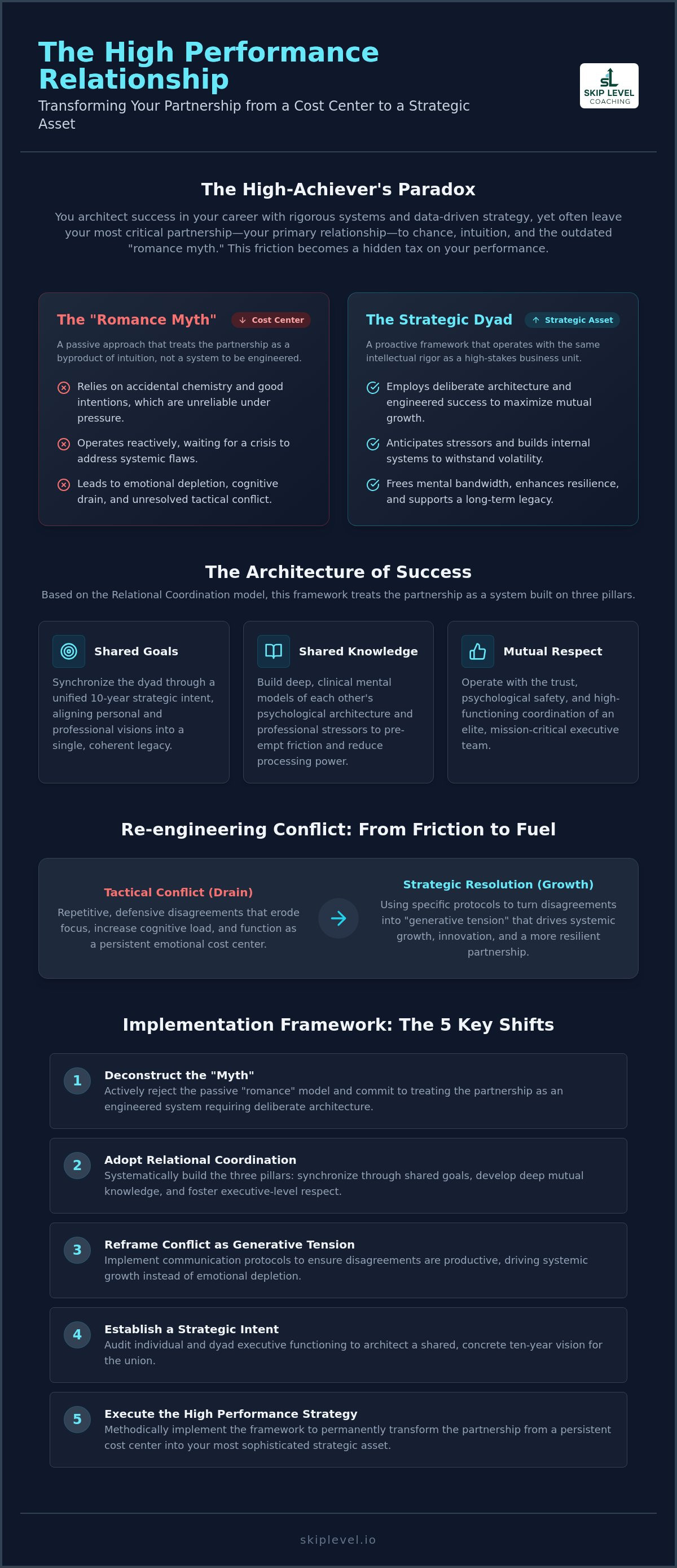
Most high-achieving individuals operate under a dangerous double standard. In the boardroom, success is the result of rigorous systems, data-driven pivots, and intentional architecture. Yet, upon returning home, these same leaders often revert to a "romance myth" that suggests a healthy interpersonal relationship should function effortlessly, guided by little more than intuition and good intentions. This passive approach is not just idealistic; it is strategically reckless. A high performance relationship strategy replaces this accidental chemistry with the deliberate engineering of a dyad's interactions to maximize mutual growth, resilience, and long-term output.
We must transition toward the concept of the Strategic Dyad. This is a partnership that operates with the same intellectual rigor as a high-stakes business unit. It recognizes that when two powerful individuals align, the resulting system requires a formal framework to manage the complexities of shared legacy, high-pressure environments, and evolving personal identities. Without this structure, the relationship becomes a "cost center" of emotional energy rather than a sophisticated strategic asset.
The Cost of Relational Friction in High-Stakes Environments
Unresolved domestic tension is never contained within the walls of a home. It bleeds into executive decision-making, erodes focus during critical negotiations, and significantly increases the cognitive load on a leader. When a partnership is disorganized, the brain remains in a state of low-level hyper-vigilance, scanning for relational threats instead of focusing on professional innovation. Relationship optimization is not a luxury or a "soft" skill. It is a prerequisite for sustainable professional sovereignty. By reducing relational friction, you liberate the mental bandwidth necessary to lead with clarity and precision.
From Accidental Chemistry to Engineered Success
The difference between a standard partnership and a strategic one lies in the shift from reactive to proactive frameworks. Reactive couples wait for a crisis to address systemic flaws. In contrast, an engineered high performance relationship strategy anticipates stressors and builds the internal architecture to withstand them. Relying on "good enough" is a high-risk gamble for power couples facing extreme external pressures. Success in this context requires clinical precision to identify and dismantle intergenerational patterns that disrupt strategy. We don't just look for "fixes"; we build a resilient system that thrives on the hard work of deliberate, goal-oriented consultation. This methodical approach ensures that the dyad remains a source of strength, even when the external landscape is volatile.
The Architecture of the Strategic Dyad: Relational Coordination
To move beyond the limitations of traditional counseling, we must apply the Relational Coordination model, originally developed by Jody Hoffer Gittell for high-stakes organizational environments, to the intimate dyad. This framework shifts the focus from emotional sentiment to systemic efficiency. In a high performance relationship strategy, the partnership is viewed as a complex adaptive system where success is measured by the quality of coordination between two high-functioning agents. This coordination is built upon three non-negotiable pillars: Shared Goals, Shared Knowledge, and Mutual Respect. When these pillars are integrated into the dyad's architecture, communication evolves from reactive or defensive exchanges into frequent, timely, and accurate interactions fundamentally focused on problem-solving.
By positioning the relationship as a system rather than a collection of fleeting feelings, couples can develop a more robust internal structure. This systems-based approach ensures that the couple can navigate external volatility without internal collapse, treating the relationship as a mission-critical unit that requires regular maintenance and strategic upgrades.
Shared Knowledge and Domestic Systems
Shared Knowledge within a strategic dyad extends far beyond knowing a partner’s schedule. It requires a deep, clinical understanding of each individual’s internal psychological architecture and their specific professional stressors. By building sophisticated mental models of one another, partners can predict responses and preemptively mitigate friction before it escalates. This cognitive alignment reduces the daily processing power required to navigate the relationship, allowing for smoother transitions between domestic and professional spheres. Those seeking to refine these internal architectures often benefit from specialized power couples coaching to map these complex dynamics and reduce systemic friction.
Mutual Respect as a Performance Metric
Within this framework, respect is not merely a moral virtue; it is a strategic requirement for high-speed coordination. If respect is compromised, the flow of information slows, and the system becomes prone to blame-based bottlenecks that stall progress. Effective conflict resolution in a high-performance setting relies entirely on the maintenance of this metric. We measure the health of respect through the lens of executive functioning: the ability to remain objective, take ownership of systemic errors, and maintain a blame-free environment. Integrating a high performance relationship strategy requires this shift in perspective, where respect serves as the primary lubricant for the dyad’s operational success, allowing the partnership to innovate and adapt during periods of intense external crisis.
Tactical Conflict vs. Strategic Resolution
A pervasive fallacy among high-achievers is the belief that a lack of friction is the ultimate metric of relationship success. You might assume that because you've mastered complex negotiations in your professional life, your personal partnership should remain perpetually harmonious. This expectation is not only unrealistic; it's strategically limiting. In a high performance relationship strategy, conflict isn't a bug in the system; it's a vital diagnostic tool. We reframe these moments as "generative tension," the necessary pressure that arises when two formidable individuals push against one another's boundaries to expand the dyad's collective capacity.
The distinction between failure and growth lies in the transition from tactical conflict to strategic resolution. Tactical conflict is reactive, ego-driven, and focused on a win-lose outcome, essentially functioning as an emotional cost center that drains your cognitive resources. Strategic resolution, however, is systemic and goal-oriented. It treats relationship ruptures with the forensic detachment of "Critical Incident" thinking, a methodology borrowed from high-stakes industries like aviation and finance. Instead of assigning blame, the dyad asks how the incident reveals a vulnerability in their shared architecture and what structural adjustments are required to prevent a recurrence.
The Mechanics of Generative Tension
High-performance dyads don't avoid disagreement; they use it to stress-test their shared goals. This process is formalized through a "Post-Incident Review" (PIR), a structured debriefing designed to extract data from a conflict without leaving emotional residue. The PIR identifies the root cause of the friction, whether it's a breakdown in communication protocols or a mismatch in executive functioning, and updates the dyad’s operating manual. Building resilience through these structured confrontations ensures that the relationship evolves in lockstep with your professional ambitions.
Power Dynamics and Sovereignty
Power couples face a unique challenge because both partners are accustomed to being the "lead" in their respective spheres. When two dominant individuals share a life, the resulting power struggle can lead to "Executive Stagnation," where the relationship becomes a source of boredom or repetitive friction. To counter this, we implement "Strategic Sovereignty." This framework allows each partner to maintain individual autonomy and specialized domains of influence within a highly coordinated union. By protecting individual sovereignty, your high performance relationship strategy ensures the partnership remains a platform for mutual empowerment rather than a competition for control. It allows the dyad to function as a sophisticated alliance of two independent leaders rather than a merger that dilutes individual strength.
Implementing a Goal-Directed Framework for Couples
Transitioning from the theory of the strategic dyad to its practical execution requires a methodical deployment of specific operational tools. A high performance relationship strategy isn't a vague ideal; it's a series of repeatable, engineered steps designed to optimize the dyad's output and resilience. This framework moves the partnership away from the "cost center" model and toward a sophisticated asset class that supports your broader legacy goals. By treating the relationship with the same rigor as a high-stakes business unit, you ensure that personal friction never compromises professional sovereignty.
To begin this transformation, couples must follow a structured implementation path:
- Step 1: Define Strategic Intent. Establish a ten-year legacy goal that encompasses wealth, impact, and family trajectory.
- Step 2: Audit Executive Functioning. Identify individual strengths and vulnerabilities in planning, cognitive flexibility, and emotional regulation that impact dyadic operations.
- Step 3: Establish a Cadence of Coordination. Implement weekly operational syncs and quarterly strategic retreats to maintain alignment.
- Step 4: Create Standard Operating Procedures (SOPs). Develop protocols for recurring stressors, such as financial management and domestic logistics, to minimize decision fatigue.
- Step 5: Integrate Intergenerational Success. Plan for the preservation and transfer of both values and assets across generations.
Defining the Strategic Intent
Most couples focus on the immediate goal of staying together, but high-performance dyads focus on building together. This shift requires aligning two distinct, high-pressure career paths into a single Master Strategy. You aren't just managing two lives; you're coordinating a unified mission. By writing a formal Relationship Mission Statement, you create a clinical guide that provides clarity during major life transitions or professional pivots. This document serves as the "North Star" for the dyad, ensuring that every tactical decision supports the long-term strategic intent of the union.
Executive Functioning in Domestic Operations
Friction often arises not from a lack of love, but from gaps in executive functioning. Gaps in planning, organization, or emotional regulation can lead to systemic breakdowns that feel personal. We solve this by identifying these gaps and determining which "low-value" relationship tasks can be outsourced or automated. This preserves your "high-value" connection time for strategic alignment and intimacy. Building this "Architecture of Independence" ensures that both partners have the internal structure and external support to thrive individually while remaining deeply coordinated. For couples ready to engineer this level of synchronization, our Power Couples Coaching provides the bespoke consultation necessary to bridge these gaps and build a lasting legacy.
Elevating the Partnership: The Skip Level Approach
The transition from theoretical frameworks to operational excellence requires more than just internal initiative; it demands the oversight of a specialist who understands both the complexities of the boardroom and the nuances of the psychological landscape. Skip Level Coaching provides this bridge through its specialized Power Couples Coaching, a high-touch service designed for dyads who demand the same level of precision in their personal lives as they do in their professional ventures. Led by Dr. Jae LaHood, a Strategic Architect with a background in clinical psychology, the methodology moves past surface-level grievances to address the underlying architecture of independence and strategic sovereignty. This is not a space for the superficiality of traditional self-help; it is a methodical, systems-based environment where the hard work of building resilience is prioritized over fleeting emotional fixes.
The Skip Level approach is fundamentally unsentimental and goal-oriented. It treats the relationship not as a fragile bond to be protected, but as a robust engine to be optimized. By focusing on sustainability and growth, the coaching process ensures that each partner maintains their individual strength while contributing to a highly coordinated, unified system. This rigorous focus on internal architecture allows the dyad to thrive under the extreme external pressures inherent in high-stakes leadership roles.
Bespoke Consultation for High-Net-Worth Dyads
High-net-worth dyads face unique systemic pressures, from the management of intergenerational wealth to the scrutiny of public-facing roles. Skip Level Coaching addresses these specific hurdles through a concierge-style consultation that is flexible, private, and intellectually rigorous. We facilitate a deliberate transition from the reactive nature of traditional clinical models toward a proactive, strategic growth consultation. This process identifies the intergenerational patterns that may be disrupting your high performance relationship strategy, replacing them with engineered protocols that support both your professional advancement and your personal legacy. The result is a bespoke roadmap that respects the complexity of your lifestyle while demanding a high degree of intellectual rigor from both partners.
Taking the Next Step Toward Relational Sovereignty
It is time to evaluate your current relationship system for its efficiency and alignment. If your partnership feels like a cost center of emotional energy, it is likely because it lacks the formal architecture required to support two high-achieving individuals. By shifting your perspective and viewing your relationship as the ultimate high-performance project, you can transform friction into a generative force. Relational sovereignty is not found by accident; it is engineered through deliberate action and expert guidance. We invite you to schedule a consultation with Skip Level Coaching to engineer your Strategic Dyad. Taking this step ensures that your most intimate partnership becomes the primary driver of your long-term success and legacy.
Engineering Relational Sovereignty for the Modern Legacy
The transition from a disorganized domestic state to a strategic dyad requires a fundamental shift in how you perceive the underlying architecture of your partnership. By replacing the romance myth with a rigorous high performance relationship strategy, you ensure that your most intimate connection functions as a sophisticated engine for mutual growth. We've explored how adopting clinical frameworks allows couples to synchronize their long-term legacy goals while maintaining the individual sovereignty required for executive performance. This methodical approach turns repetitive friction into generative data. It allows the dyad to adapt amidst the volatility of high-stakes environments. You don't have to settle for a system that drains your cognitive resources.
Skip Level Coaching, founded by Dr. Jae LaHood, PsyD, specializes in bridging the gap between psychological depth and professional excellence through bespoke consultation. Whether you require expertise in Critical Incident Consultation or a focus on Strategic Growth and Sustainable Transitions, our methodology provides the internal architecture necessary for long-term resilience. Secure your partnership's future with Skip Level Power Couples Coaching. Building a relationship that matches the caliber of your professional success is a deliberate, engineered journey that yields profound rewards for your legacy.
Frequently Asked Questions
What is the difference between traditional marriage counseling and a high performance relationship strategy?
Traditional marriage counseling typically centers on emotional repair and the resolution of acute distress, whereas a high performance relationship strategy focuses on the deliberate engineering of a functional dyad. This approach treats the partnership as a sophisticated strategic asset rather than a project for emotional maintenance. It prioritizes the creation of systems that maximize mutual output and resilience, ensuring that the partnership supports the couple’s broader professional ambitions and long-term legacy.
Can a high performance strategy work if only one partner is a high achiever?
Success is possible provided both partners are committed to the architectural rigor required for systemic coordination. While the external stressors may differ, the internal requirement for shared goals and mutual respect remains constant. The strategy focuses on aligning the dyad's collective executive functioning to support the primary driver of the family’s legacy. It's about ensuring the partnership functions as a unified system, regardless of individual professional titles.
How do we find time for a 'strategic relationship' when we are both C-suite executives?
Time is recovered by formalizing the relationship's operational cadence, treating the partnership with the same priority as a C-suite board meeting. This involves implementing weekly synchronization meetings and quarterly retreats to ensure systemic alignment. By outsourcing or automating low-value domestic tasks, you preserve the cognitive bandwidth necessary for high-value strategic coordination. This methodical approach reduces decision fatigue and ensures the dyad remains a source of energy rather than a cost center.
Is conflict a sign that our relationship strategy is failing?
Conflict serves as a vital diagnostic tool within a high performance relationship strategy, indicating where the system requires structural adjustment. We reframe these moments as generative tension rather than emotional failures, using them to stress-test the dyad’s shared goals. Strategic resolution involves a forensic post-incident review to extract actionable data, which is then used to update the relationship’s operating protocols. This process builds systemic resilience and prevents the accumulation of emotional residue.
How does 'executive functioning' impact our relationship satisfaction?
Executive functioning skills, such as cognitive flexibility and emotional regulation, are the operational tools that determine how smoothly a dyad coordinates. Gaps in these areas often manifest as repetitive friction or disorganized domestic operations, which erodes relationship satisfaction. Improving these systems allows for more efficient problem-solving and reduces the emotional cognitive load on both partners. When these internal architectures are optimized, the relationship functions with significantly higher precision and less friction.
What are the common intergenerational patterns that disrupt power couples?
Power couples often encounter patterns of hyper-independence or competitive leadership inherited from their family systems. These intergenerational blueprints can cause partners to operate as silos rather than a coordinated unit, leading to persistent power struggles. Identifying these patterns through a clinical lens allows the dyad to dismantle outdated scripts and build a bespoke architecture for their shared sovereignty. It's about moving past inherited behaviors to create a system that serves your current strategic intent.
How often should a high-performance couple perform a 'strategic audit' of their relationship?
A comprehensive strategic audit should occur at least once per year, with lighter quarterly reviews to track alignment and progress. These audits assess the health of the dyad’s relational coordination, financial systems, and long-term legacy goals. Frequent auditing ensures that the partnership evolves in lockstep with professional pivots and prevents the accumulation of unaddressed systemic friction. It keeps the relationship proactive rather than reactive to the pressures of a high-stakes lifestyle.
Can this strategy help with 'failure to launch' issues in our adult children?
Our methodology extends to family systems, specifically through Emerging Adulthood Coaching, to address the architectural flaws that contribute to domestic stagnation. By identifying intergenerational patterns that hinder autonomy, we help adult children build the internal structure required for self-governance. This shift allows parents to move away from reactive crisis management and return their focus to the strategic coordination of their own dyad, ensuring that the entire family system operates with precision.